
Peptic Ulcer Treatment: Looking Beyond Temporary Symptom Relief
Peptic ulcers can cause a level of digestive discomfort that slowly starts affecting everyday life.
For some people, it begins as occasional burning or reflux after meals. Others notice ongoing stomach irritation, bloating, nausea, or discomfort that never seems to fully settle down for long.
Most people eventually end up choosing between two general approaches.
One focuses mainly on temporary symptom relief through medications designed to reduce pain or stomach acid. The other looks more closely at underlying digestive factors that may be contributing to recurring irritation in the first place, including Helicobacter pylori (H. pylori).
Understanding the difference between those approaches can help you make more informed decisions about what direction feels right for you long term.

Why Temporary Relief Often Has Limits
Antacids, acid blockers, and pain medications are commonly used to reduce ulcer-related discomfort. For many individuals, they may temporarily ease symptoms such as burning, reflux, or stomach pain.
The problem is that relief often fades once the medication wears off.
That does not necessarily mean these treatments have no value. Conventional therapies remain important tools for many individuals dealing with peptic ulcers and ongoing digestive symptoms.
But symptom relief alone does not always explain why the irritation keeps returning.
For many people, H. pylori becomes part of that conversation.
Over time, some individuals notice a frustrating pattern where symptoms improve briefly, only to gradually cycle back again after stopping medications or relaxing dietary restrictions.
That recurring cycle is often what pushes people to start researching broader digestive approaches instead of focusing only on short-term symptom management.
Understanding H. pylori and Ongoing Digestive Irritation
H. pylori is one of the most common bacterial infections worldwide. Research suggests that more than half the global population may carry it, often without realizing it initially.
Some individuals never develop noticeable symptoms.
Others begin experiencing recurring digestive issues such as bloating, nausea, reflux, stomach discomfort, excessive burping, or irritation after eating.
In some cases, long-term stomach inflammation associated with H. pylori may contribute to gastritis or peptic ulcers over time.
That is one reason testing and proper medical evaluation remain important, particularly when symptoms become persistent or progressively more disruptive.
Keeping track of symptom patterns, dietary triggers, and treatment responses can also help individuals have more productive conversations with their healthcare providers.

Conventional Treatment Options
Triple therapy remains one of the most common conventional treatment approaches for H. pylori. This typically involves two antibiotics combined with an acid-reducing medication.
For many individuals, these therapies may still work successfully.
At the same time, some people report side effects involving nausea, diarrhea, digestive disruption, or bloating during treatment. Researchers also continue monitoring growing antibiotic resistance involving H. pylori worldwide, particularly in relation to antibiotics such as clarithromycin and metronidazole.
That does not mean conventional therapies should be avoided. Healthcare professionals continue playing an important role in diagnosis, testing, and treatment planning.
But it does help explain why some individuals later begin researching additional digestive approaches as part of their broader long-term strategy.

Looking Beyond One Single Approach
Once people begin researching peptic ulcers and H. pylori more seriously, they often discover there is no single path everyone follows.
Some individuals rely primarily on conventional treatment.
Others begin exploring additional digestive approaches alongside medical care after dealing with recurring symptoms, difficult side effects, or ongoing frustration trying to stabilize digestion long term.
The goal for many people is not simply finding “another remedy.”
It is finding a process that feels realistic, manageable, and easier to follow consistently without constantly changing direction every few weeks.

The 30-Day Matula Tea™ Program
The 30-day Matula Tea™ program was developed specifically around H. pylori-related digestive concerns.
Rather than functioning as a broad digestive cleanse or generalized supplement stack, the program follows a more defined daily routine built around digestive balance, stomach comfort, and consistency over a 30-day period.
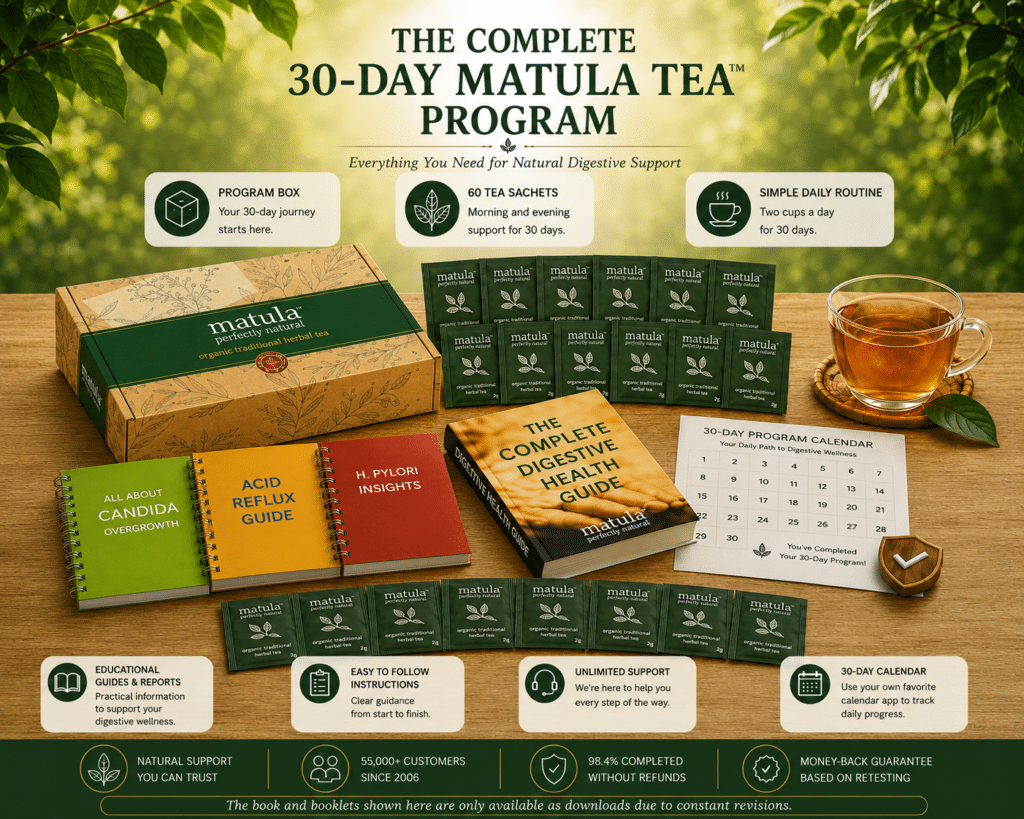
The herbal blend contains wild-grown South African herbs traditionally associated with digestive health.
Part of the attention surrounding Matula Tea™ came from independent laboratory testing conducted by Professor Patrick JD Bouic Ph.D., a world-renowned immunologist and co-founder of Synexa Life Sciences.
In vitro testing explored antibacterial activity involving the herbal blend and clinical strains of Helicobacter pylori under controlled laboratory conditions.
Importantly, laboratory findings should always be interpreted carefully. Laboratory conditions cannot be directly replicated inside the human body, and individual experiences naturally vary.
Still, the research helped distinguish Matula Tea™ from many general digestive products that were never specifically evaluated in relation to H. pylori.
~ Trusted by 55,000+ people since 2006 ~ 100% natural ~ Money-back guarantee ~
Other Digestive Approaches Commonly Discussed
Several natural approaches are frequently discussed alongside peptic ulcer and H. pylori conversations.
Mastic gum has long been used in traditional digestive practices and is sometimes explored for its relationship to microbial balance and stomach comfort. Probiotics are commonly used to help maintain healthy gut flora, particularly during or after antibiotic use.
Some individuals also incorporate foods and ingredients such as Manuka honey, green tea, broccoli sprouts, or licorice root into their routines because of their association with digestive health and stomach comfort.
These approaches are generally viewed as part of broader digestive management strategies rather than standalone solutions.
Why Consistency Matters More Than Constant Experimentation
One thing many individuals eventually realize is how exhausting constant protocol switching can become.
A supplement for a few weeks. Then another. A restrictive diet. A new recommendation online.
After a while, people often stop feeling like they are following a clear plan and start reacting to symptoms day by day instead.
That uncertainty can make digestion feel even harder to manage consistently.
For many individuals, the appeal of a more focused 30-day digestive program has less to do with hype and more to do with simplicity. A defined timeframe, a clear daily process, ongoing guidance, and fewer moving parts often feel easier to follow than constantly piecing together disconnected approaches.
Choosing Your Next Step
At some point, most people dealing with recurring digestive discomfort have to decide whether they only want temporary symptom relief… or whether they also want to better understand the broader digestive factors contributing to the problem.
That answer looks different for everyone.
Some individuals begin with conventional treatment alone. Others combine medical care with dietary adjustments, probiotics, digestive routines, or more structured natural approaches over time.
The important thing is choosing an approach you can realistically stay consistent with while continuing to work with qualified healthcare professionals where appropriate.

Learn More Before You Decide
If you are currently researching H. pylori-related digestive concerns and trying to better understand the different approaches available, these questions may help you think more clearly before deciding on your next step.
While many people successfully clear H. pylori with conventional treatment, others report challenging side effects, lingering digestive symptoms, or the need for additional treatment rounds. Experiences like these help explain why some individuals continue researching broader digestive health strategies even after completing therapy.
Before making your next decision, we recommend taking a few minutes to step back and evaluate all of your options carefully.
Many people find that gaining clarity around these questions helps them move forward with greater confidence and less uncertainty.
This program is designed to support general digestive wellness and provide a structured approach. It is not intended as medical advice or a replacement for professional care. Statements on this website have not been evaluated by the Food and Drug Administration. This product is not intended to diagnose, treat, cure, or prevent any disease.
FAQ’s
H. pylori infection is considered one of the leading causes of peptic ulcers worldwide, alongside long-term use of NSAID medications such as ibuprofen or aspirin.
Some individuals experience recurring digestive irritation because symptom-relief approaches may not fully address underlying digestive factors contributing to the discomfort.
Triple therapy is a conventional treatment approach that usually combines two antibiotics with an acid-reducing medication.
Some people researching recurring digestive discomfort and H. pylori-related concerns prefer a more focused daily routine instead of constantly switching between multiple digestive products or protocols.
Yes. Independent in vitro laboratory testing explored antibacterial activity involving the herbal blend and clinical strains of Helicobacter pylori under controlled conditions.
Probiotics are commonly discussed because they may help maintain healthy gut flora and digestive balance, particularly during or after antibiotic use.
Key Takeaways
- Short-term relief options can ease symptoms but may not address underlying factors like H. pylori.
- H. pylori is common and often linked to ongoing digestive discomfort.
- Matula Tea is a 30-day herbal program designed to support digestive wellness.
- Other options, such as probiotics and mastic gum, may support gut balance but are often used alongside broader strategies.
- A structured plan with support and consistency can help you manage your digestive health more effectively.
References
StatPearls — Peptic Ulcer Disease (Updated 2024)
https://www.ncbi.nlm.nih.gov/books/NBK534792/
National Institute of Diabetes and Digestive and Kidney Diseases — Peptic Ulcers (Stomach Ulcers) (Updated 2024)
https://www.niddk.nih.gov/health-information/digestive-diseases/peptic-ulcers-stomach-ulcers
Johns Hopkins Medicine — Peptic Ulcer Disease (Updated 2024)
https://www.hopkinsmedicine.org/health/conditions-and-diseases/peptic-ulcer-disease
World Journal of Gastroenterology — Helicobacter pylori-associated Peptic Ulcer Disease (Published 2023)
https://pmc.ncbi.nlm.nih.gov/articles/PMC10202071/
Frontiers in Microbiology — Treatment of Refractory Helicobacter pylori Infection (Published 2022)
https://www.frontiersin.org/articles/10.3389/fmicb.2022.998240/full