
Understanding How H. pylori Can Spread Within Households
When one person in a household is diagnosed with H. pylori, a common question quickly follows:
“Could my partner or family members have it too?”
It’s a reasonable concern.
H. pylori is a highly adaptable bacterium that can spread between people through close contact, contaminated food or water, and certain hygiene-related pathways. Because family members share living spaces, meals, utensils, and daily routines, understanding the possibility of transmission is important when evaluating the next steps.
While not everyone exposed to H. pylori becomes infected, awareness of how the bacterium spreads can help reduce unnecessary risk and provide greater peace of mind for everyone in the household.

Can H. pylori Spread Between Partners?
Research suggests that H. pylori can spread through close personal contact, particularly when saliva, vomit, or fecal matter is involved.
Because couples often share food, drinks, utensils, and close physical contact, partner transmission is frequently discussed when someone receives a positive H. pylori diagnosis.
This doesn’t mean every partner will automatically become infected. However, it does explain why healthcare providers sometimes recommend that close family members remain aware of symptoms and consider testing if appropriate.
Understanding the potential routes of transmission helps households make informed decisions rather than relying on assumptions.
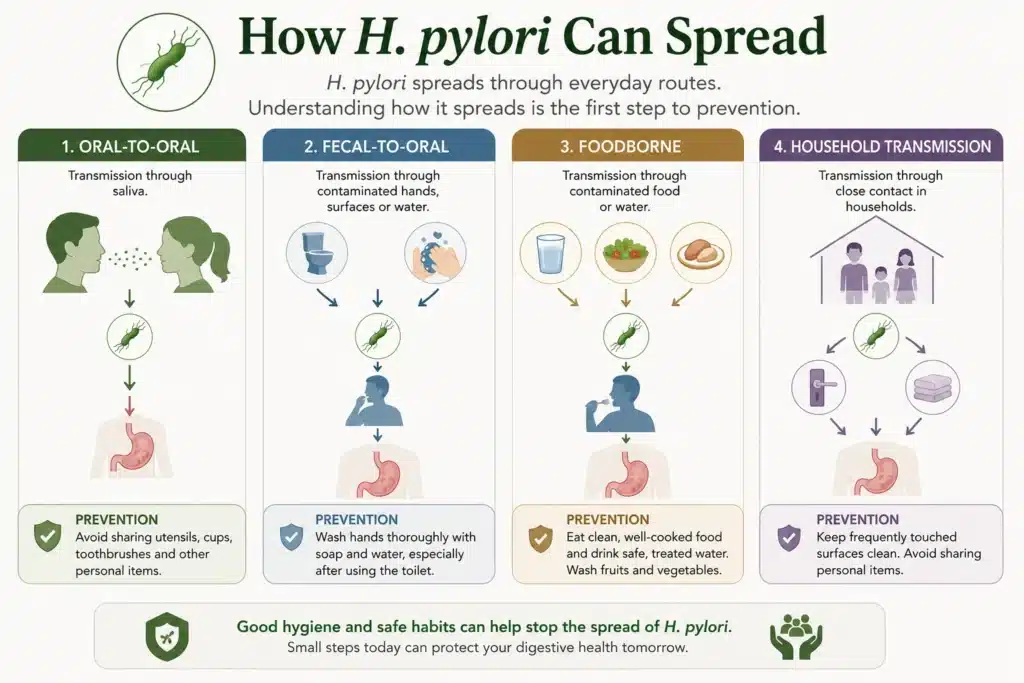
Common Ways H. pylori May Spread
Although H. pylori transmission is still being studied, several pathways are considered the most likely.
Oral-to-Oral Transmission
Saliva is one of the most discussed transmission routes.
Activities such as kissing, sharing utensils, sharing drinks, or eating from the same plate may increase opportunities for exposure.
Fecal-to-Oral Transmission
H. pylori has also been detected in fecal matter.
Poor hand hygiene after using the bathroom can potentially contribute to transmission, particularly within households where multiple people share facilities.
Contaminated Food and Water
In some regions, contaminated food or water may contribute to infection rates. This is one reason proper food handling and access to clean drinking water remain important public health measures.
Shared Personal Items
Sharing toothbrushes, towels, or other personal hygiene items may increase exposure opportunities and is generally discouraged.
Why Testing Can Be Important
One challenge with H. pylori is that not everyone experiences obvious symptoms.
Some people may have significant digestive discomfort, while others remain completely unaware they carry the bacterium.
This can create uncertainty within households.
If one family member tests positive, questions often arise about whether others should also be evaluated.
Rather than guessing, testing can help determine whether H. pylori is present and allow individuals to discuss appropriate options with their healthcare provider.
In some situations, identifying the infection early may also help reduce the likelihood of ongoing digestive complications associated with long-term infection.
The Household Reinfection Question
One concern sometimes raised is the possibility of reinfection or ongoing transmission within a household.
If one person receives treatment while another household member remains infected, some people worry that the bacterium could continue circulating within the home.
This is one reason why testing and open communication may be helpful when H. pylori is identified within a family.
The appropriate approach will vary depending on individual circumstances, medical history, symptoms, and professional guidance.
Rather than assuming everyone requires treatment, obtaining accurate information first is generally the most productive step.

Practical Steps to Reduce Transmission Risk
Although no prevention strategy can eliminate risk entirely, several practical habits may help reduce exposure opportunities within the home.
These include:
- Washing hands thoroughly after using the bathroom
- Avoiding shared toothbrushes
- Limiting the sharing of eating utensils and drinking containers
- Maintaining good kitchen hygiene
- Properly washing and preparing food
- Using clean drinking water sources where possible
These measures support overall household hygiene and may help reduce the likelihood of spreading various infections, including H. pylori.
Exploring Natural Digestive Wellness Approaches
Once people begin researching H. pylori, they often encounter a wide range of treatment and digestive wellness options.
Conventional antibiotic-based therapies remain the most common medical approach and have helped many individuals successfully address H. pylori infections.
At the same time, some people explore additional digestive wellness strategies either during or after treatment.
One option that has attracted attention over the years is the 30-day Matula Tea™ program.
The program provides a defined daily routine built around a proprietary herbal formulation and is designed for individuals exploring natural approaches to digestive wellness and H. pylori-related concerns.
This program is designed to support general digestive wellness and provide a structured approach. It is not intended as medical advice or a replacement for professional care. Statements on this website have not been evaluated by the Food and Drug Administration. This product is not intended to diagnose, treat, cure, or prevent any disease.

Protecting Your Household Starts With Awareness
When it comes to H. pylori and partner transmission, awareness is often the most valuable first step.
Understanding how the bacterium may spread, recognizing potential symptoms, and knowing when testing may be appropriate can help reduce uncertainty and support more informed decisions.
For some families, the next step may be testing. For others, it may be learning more about available treatment and digestive wellness approaches.
Either way, having accurate information allows you to move forward with greater confidence.
This content is provided for educational and informational purposes only. It is not intended as medical advice or a substitute for consultation with a qualified healthcare provider. Always seek the advice of your doctor or other qualified health professional with any questions you may have regarding a medical condition.
Looking at Your Options More Closely
Many people begin researching H. pylori after discovering that symptoms affect more than one person in the household.
Others start asking questions after repeated digestive issues, uncertainty about reinfection, or concerns about what to do next after a positive test result.
If you’re currently evaluating different approaches and trying to make sense of the available options, the guide below may help.
It was created to help people compare approaches more objectively, understand important considerations before choosing a program, and reduce confusion during the decision-making process.
References
Johns Hopkins Medicine – Helicobacter Pylori
https://www.hopkinsmedicine.org/health/conditions-and-diseases/helicobacter-pylori
Cleveland Clinic – H. pylori Infection
https://my.clevelandclinic.org/health/diseases/21463-h-pylori-infection
StatPearls – Helicobacter pylori Infection
https://www.ncbi.nlm.nih.gov/books/NBK534233/
World Gastroenterology Organisation – Helicobacter pylori Guidelines
https://www.worldgastroenterology.org/guidelines/global-guidelines/helicobacter-pylori