
Why Understanding the Cause Is Often the First Step
If you’re dealing with a stomach ulcer, one of the most important questions to ask is not simply how to relieve symptoms, but why the ulcer developed in the first place.
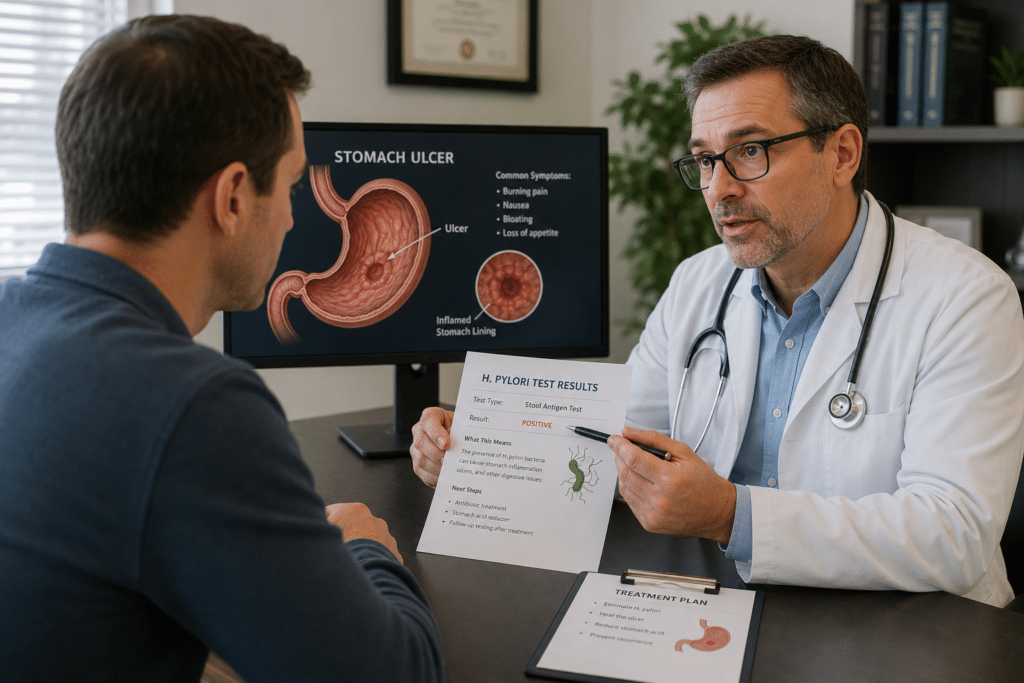
For many people, ulcers are linked to Helicobacter pylori (H. pylori), a bacterium that can affect the stomach’s protective lining and contribute to ongoing irritation. Others may develop ulcers after prolonged use of nonsteroidal anti-inflammatory drugs (NSAIDs) such as ibuprofen or aspirin.
Understanding the underlying cause matters because different causes often require different approaches. Identifying what’s driving the problem can help guide testing, treatment decisions, and the conversations you have with your healthcare provider.
For some individuals, that process eventually leads to broader questions about digestive recovery, symptom persistence, and what options may be worth exploring after diagnosis.
What Causes Most Stomach Ulcers?
Although stomach ulcers can develop for several reasons, two factors account for the majority of cases:
- H. pylori infection
- Long-term NSAID use
When H. pylori is involved, the bacteria can weaken the stomach’s protective mechanisms, making the lining more vulnerable to irritation and damage over time.
This is why healthcare professionals often recommend testing for H. pylori when ulcers are suspected.
Identifying the cause helps answer an important question:
What should happen next?
Without understanding the cause, people often spend months trying to manage symptoms without addressing the underlying issue.
The Important Connection Between H. pylori and Ulcers
For many years, ulcers were blamed primarily on stress, spicy foods, and excess stomach acid.
The discovery of H. pylori changed that understanding dramatically.
Researchers now recognize that H. pylori plays a significant role in many ulcer cases worldwide.
For people dealing with recurring upper abdominal discomfort, bloating, reflux, indigestion, or stomach irritation, determining whether H. pylori is involved can provide valuable clarity.
Understanding that connection may influence everything from testing decisions to treatment discussions and long-term digestive health planning.

Why Recovery Sometimes Takes Longer Than Expected
Many people assume that once treatment begins, symptoms will disappear quickly.
In reality, recovery can be more gradual.
Even when the underlying cause is identified and addressed, the stomach lining still requires time to recover from irritation and damage that may have developed over months or years.
This is one reason some individuals continue experiencing symptoms such as bloating, discomfort, reflux, or sensitivity to certain foods even after treatment has begun.
That can be frustrating.
People often start questioning whether treatment is working, whether they should try something else, or whether they are missing an important piece of the puzzle.
Understanding that healing is not always immediate can help create more realistic expectations and reduce unnecessary uncertainty.

Conventional Approaches to H. pylori-Related Ulcers
The conventional approach to H. pylori-associated ulcers typically involves antibiotics together with acid-reducing medications.
Triple therapy and quadruple therapy remain widely used treatment strategies and help many people successfully address the infection.
Healthcare professionals play an essential role in:
- diagnosis
- testing
- treatment planning
- monitoring progress
- evaluating complications
At the same time, treatment experiences are not identical for everyone.
Some individuals require additional testing, different medications, or follow-up treatment. Researchers also continue monitoring antibiotic resistance patterns among certain H. pylori strains, which can make treatment planning more complex in some situations.
Why Some People Continue Looking for Additional Options
While many people complete treatment and move on, others continue researching after experiencing lingering symptoms, side effects, repeat testing, or uncertainty about what to do next.
This does not necessarily mean treatment was unsuccessful.
Rather, it reflects the reality that digestive recovery can sometimes involve additional questions and decisions.
Some people become interested in dietary changes.
Others investigate digestive wellness programs, probiotics, or broader approaches to supporting stomach health during recovery.
The common thread is usually the same:
People want greater clarity about how to move forward.

The 30-Day Matula Tea™ Program
The 30-day Matula Tea™ program was developed specifically for individuals researching H. pylori-related digestive concerns.
Rather than combining numerous supplements or requiring a complicated protocol, the program centers around a simple twice-daily tea routine.
The broader program includes:
- Matula Tea™ sachets
- preparation instructions
- educational resources
- customer support
- a money-back guarantee
The herbal blend contains wild-grown South African herbs traditionally associated with digestive wellness and stomach comfort.
For some people, the appeal lies in having a clearly defined process rather than continually changing products or experimenting with multiple protocols at once.

This program is designed to support general digestive wellness and provide a structured approach. It is not intended as medical advice or a replacement for professional care. Statements on this website have not been evaluated by the Food and Drug Administration. This product is not intended to diagnose, treat, cure, or prevent any disease.
Independent Laboratory Testing and Long-Term Customer Experience
Part of the early attention surrounding Matula Tea™ came from independent laboratory testing conducted by Professor Patrick JD Bouic, Ph.D., an internationally recognised immunologist and co-founder of Synexa Life Sciences.
“…the most exciting results obtained were when clinical strains of Helicobacter pylori were assayed… the Matula Tea extract proved its efficacy in killing off the strains.”
The testing explored antibacterial activity involving the herbal blend and clinical strains of H. pylori under controlled laboratory conditions.

Professor Patrick JD Bouic Ph.D.
World-Renowned Immunologist
Professor Bouic is a co-founder of Synexa Life Sciences (Pty) Ltd and heads the company’s BioAnalytical Services Unit. He has more than 30 years of experience in immunopathology.
“…the most exciting results obtained were when clinical strains of Helicobacter Pylori were assayed…” – these results showed clear evidence that Matula Tea demonstrated a significant level of antibacterial activity against H. pylori strains in laboratory (in vitro) testing.
NOTE: These laboratory findings relate to in vitro testing conditions and should not be interpreted as guaranteed clinical outcomes in humans.
Part of the early attention surrounding Matula Tea™ came from independent laboratory testing conducted by Professor Patrick JD Bouic Ph.D., a world-renowned immunologist and co-founder of Synexa Life Sciences.
In vitro laboratory testing evaluated the active liquid extract of Matula Tea™ against clinical strains of Helicobacter pylori under controlled laboratory conditions.
Professor Bouic stated:
“…the most exciting results obtained were when clinical strains of Helicobacter pylori were assayed..”
Those results can be seen in the full lab report which you can see here;
Importantly, laboratory findings should always be interpreted carefully. Laboratory conditions cannot be directly replicated inside the human body, and individual experiences naturally vary.
Still, the research helped distinguish Matula Tea™ from many general digestive products that were never specifically evaluated in relation to H. pylori.
Evaluating What Makes Sense for Your Situation
Every person’s circumstances are different.
Some people find conventional treatment provides the outcome they hoped for.
Others continue researching after recurring symptoms, retreatment, side effects, or ongoing digestive concerns.
The goal is not to find a universal solution.
The goal is to make an informed decision based on your individual situation, priorities, and level of comfort with the available options.
Before You Choose Your Next Step
If you’re comparing H. pylori-related options, it’s easy to focus on claims, ingredients, or price alone.
Yet those factors rarely tell the whole story.
Questions about evidence, simplicity, support, guarantees, and long-term practicality often matter just as much.
That’s why we created a decision guide designed to help people evaluate different approaches more objectively before committing to their next step.
7 Questions to Ask Before Choosing Any H. pylori Program
This content is provided for educational and informational purposes only. It is not intended as medical advice or a substitute for consultation with a qualified healthcare provider. Always seek the advice of your doctor or other qualified health professional with any questions you may have regarding a medical condition.
References
World Gastroenterology Organisation – Helicobacter pylori Guidelines
https://www.worldgastroenterology.org/guidelines/global-guidelines/helicobacter-pylori
American College of Gastroenterology – Management of Helicobacter pylori Infection
https://gi.org/journals-publications/ebgi/schoenfeld_sep2024/
StatPearls – Peptic Ulcer Disease
https://www.ncbi.nlm.nih.gov/books/NBK534792/
MedlinePlus – Peptic Ulcer
https://medlineplus.gov/pepticulcer.html
National Cancer Institute – Helicobacter pylori (H. pylori) and Cancer
https://www.cancer.gov/about-cancer/causes-prevention/risk/infectious-agents/h-pylori-fact-sheet