
Why Reflux Symptoms Aren’t Always as Simple as They Seem
For many people, GERD feels straightforward: stomach acid rises into the esophagus and causes burning, discomfort, and irritation. But when symptoms persist despite dietary changes, acid-reducing medication, or lifestyle adjustments, the picture can become far more complicated.
One factor that is often overlooked is H. pylori.
This stomach-dwelling bacterium has a surprisingly complex relationship with reflux. In some situations it appears to reduce acid production and lessen reflux symptoms. In others, it may contribute to stomach irritation and make symptoms worse.
Understanding that relationship can help explain why GERD responds differently from person to person—and why a more individualized approach is often necessary.
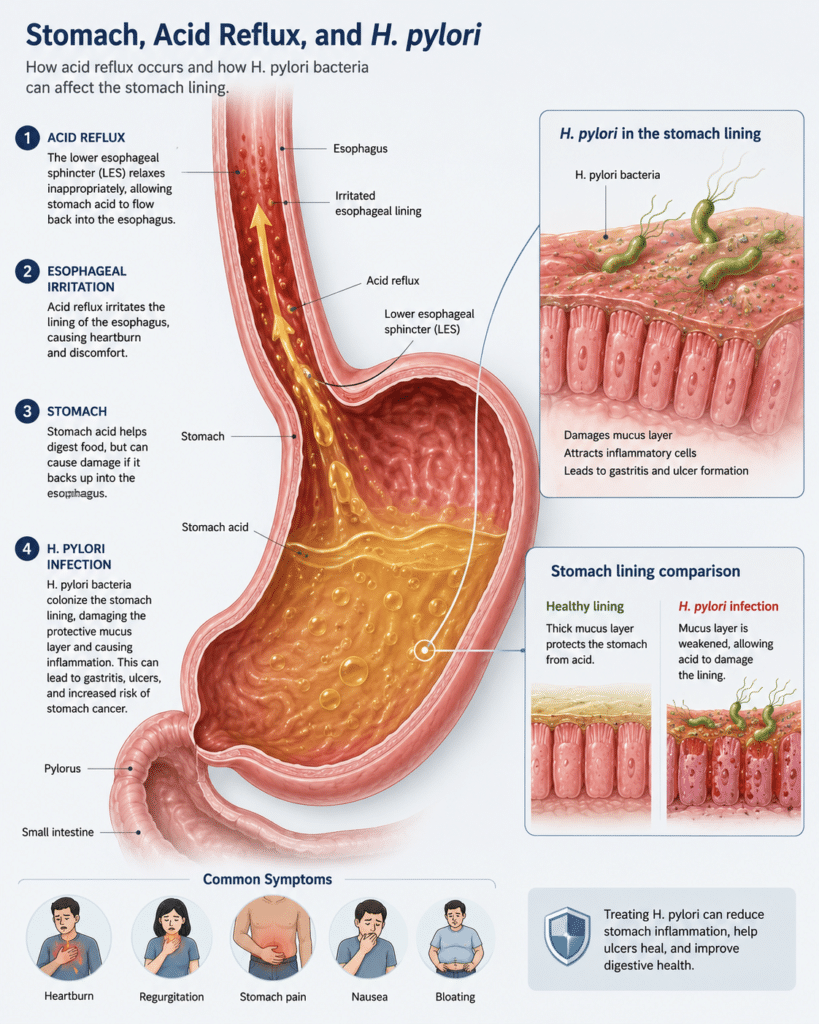
Understanding GERD and Its Common Triggers
GERD (Gastroesophageal Reflux Disease) occurs when stomach contents repeatedly flow back into the esophagus. Over time, this can lead to persistent discomfort and irritation.
Typical symptoms include:
- Heartburn
- Acid reflux
- Regurgitation
- Chest discomfort
- Chronic throat irritation
- Difficulty swallowing
A variety of factors may contribute to reflux symptoms. Large meals, excess body weight, alcohol, caffeine, smoking, and lying down shortly after eating are among the most common triggers.
Sleep quality and stress levels can also influence how frequently symptoms occur.
For many people, managing GERD begins with lifestyle adjustments. However, when symptoms continue despite these changes, it may be worth looking deeper into potential underlying contributors.

H. pylori: More Than Just an Ulcer-Associated Bacterium
Most people know H. pylori because of its association with stomach ulcers, but its effects can extend beyond ulcer development.
H. pylori colonizes the stomach lining and may influence acid production, digestive function, and stomach inflammation. Depending on where the bacterium is concentrated within the stomach, its impact can vary considerably.
This is where the relationship between GERD and H. pylori becomes particularly interesting.
In some individuals, the bacterium appears to suppress acid production. In others, it may contribute to conditions that encourage greater acid output.
As a result, the presence of H. pylori does not automatically predict whether reflux symptoms will improve or worsen.

When H. pylori Appears to Reduce Reflux Symptoms
One of the more surprising findings from digestive health research is that certain H. pylori infections may have a protective effect against reflux.
When inflammation affects acid-producing cells within the stomach, acid output can decrease. For some individuals, lower acid production may mean fewer reflux episodes and less severe heartburn.
Research has reported lower reflux severity among some H. pylori-positive individuals compared with those who do not carry the bacterium.
These findings challenge the assumption that H. pylori is always making digestive symptoms worse.
However, this is only one side of the story.
When H. pylori Can Make GERD Worse
In other cases, H. pylori may contribute to increased acid production and worsening reflux symptoms.
This is often seen when inflammation develops primarily in the lower portion of the stomach, known as the antrum.
Antral-predominant gastritis may stimulate increased gastrin production, which can encourage the stomach to produce more acid. More acid can lead to more frequent reflux episodes, greater irritation, and increased discomfort.
This variation helps explain why two people with both GERD and H. pylori may experience very different symptoms.
The relationship is highly individual, which is why blanket assumptions rarely provide the full answer.

Should H. pylori Be Addressed?
For individuals diagnosed with H. pylori, healthcare providers often recommend eradication therapy using antibiotics and acid-suppressing medication.
When H. pylori-related gastritis is contributing to symptoms, successful treatment may reduce inflammation and improve digestive comfort.
However, some researchers have observed that a small percentage of people experience increased acid production after eradication, potentially affecting reflux symptoms.
This does not mean treatment should be avoided. Rather, it highlights the importance of understanding the individual’s situation before deciding on a course of action.
The most effective approach is typically based on proper testing, medical evaluation, and ongoing monitoring of symptoms.
Why Some People Explore Natural Approaches
Not everyone looking into H. pylori is focused solely on conventional treatment options.
Some people begin researching alternatives after experiencing side effects from previous protocols. Others are simply interested in approaches that align more closely with their personal preferences.
One option that has attracted attention over the years is the 30-day Matula Tea™ program.
The program uses a blend of wild-harvested herbs and has been the subject of independent laboratory investigation. Since 2006, it has been used by thousands of customers worldwide who are looking for a natural approach to digestive wellness.
Unlike many approaches that involve multiple supplements and changing protocols, the program follows a single defined routine over a 30-day period.
This program is designed to support general digestive wellness and provide a structured approach. It is not intended as medical advice or a replacement for professional care. Statements on this website have not been evaluated by the Food and Drug Administration. This product is not intended to diagnose, treat, cure, or prevent any disease.
A Practical Next Step for People Evaluating Their Options
GERD and H. pylori share a relationship that is far more complex than many people realize.
In some cases, H. pylori may contribute to reflux symptoms. In others, it may influence stomach acid production in ways that complicate the picture even further.
That complexity is one reason why so many people continue researching after receiving a diagnosis. Understanding the role H. pylori may be playing in your specific situation can help you make more informed decisions about what to do next.

Related Information
GERD and H. pylori can be difficult to evaluate because symptoms often overlap with other digestive conditions. If you’re continuing your research, the following resources may help you better understand the connection between reflux, stomach health, and H. pylori.
H. pylori Symptoms List
https://matula-naturals.com/h-pylori-symptoms-list/
Learn about the most common digestive and non-digestive symptoms associated with H. pylori infection.
Looking Beyond Triple Therapy
https://matula-naturals.com/looking-beyond-triple-therapy/
Explore why some people continue researching additional options after conventional H. pylori treatment.
Fear of Reinfection – or Retreatment?
https://matula-naturals.com/fear-of-reinfection-or-retreatment/
A closer look at common concerns people have after treatment and why ongoing symptoms can sometimes create uncertainty.
What 55,000 Customers Have Taught Us About H. pylori
https://matula-naturals.com/what-55000-customers-have-taught-us-about-h-pylori/
Insights gathered from years of customer feedback and digestive health experiences.
7 Questions To Ask Before Choosing Any H. pylori Program
Before choosing any H. pylori approach, it can be helpful to step back and evaluate your options carefully.
While many people successfully complete conventional treatment, others continue searching for answers after experiencing side effects, lingering symptoms, or the need for additional treatment rounds.
This short question-based guide may help you better understand the different approaches available and think more clearly before deciding on your next step.
This content is provided for educational and informational purposes only. It is not intended as medical advice or a substitute for consultation with a qualified healthcare provider. Always seek the advice of your doctor or other qualified health professional with any questions you may have regarding a medical condition.
References
National Institute of Diabetes and Digestive and Kidney Diseases (NIDDK) – Symptoms & Causes of GER & GERD
https://www.niddk.nih.gov/health-information/digestive-diseases/acid-reflux-ger-gerd-adults/symptoms-causes
Mayo Clinic – GERD
https://www.mayoclinic.org/diseases-conditions/gerd/symptoms-causes/syc-20361940
Medical News Today – H. pylori Infection
https://www.medicalnewstoday.com/articles/154822
Healthline – Helicobacter pylori Infection
https://www.healthline.com/health/h-pylori-infection
National Institute of Diabetes and Digestive and Kidney Diseases (NIDDK) – Helicobacter pylori and Peptic Ulcers
https://www.niddk.nih.gov/health-information/digestive-diseases/h-pylori-peptic-ulcers