
H. pylori and Pregnancy: What Expectant Mothers Should Know
If you are pregnant and have been diagnosed with Helicobacter pylori (H. pylori), you may have questions about what the infection means for you and your developing baby.
H. pylori is a bacterium that lives in the stomach lining. Researchers have investigated possible links between infection during pregnancy and conditions such as severe pregnancy-related vomiting, iron-deficiency anaemia and pre-eclampsia.
Some studies have reported associations, but the evidence does not establish that H. pylori causes these complications. It also does not mean that every pregnant woman with H. pylori faces an increased risk.
This guide examines what researchers currently know, what remains uncertain and why testing or treatment decisions during pregnancy need individual medical assessment.
What Is H. pylori?
H. pylori is a bacterium that can colonise the stomach lining. It can cause chronic inflammation, known as chronic gastritis, and may contribute to peptic ulcers in some people.
Many people carry H. pylori without experiencing noticeable symptoms. Others develop upper abdominal discomfort, indigestion, nausea or bloating.
The infection often begins during childhood and can remain in the stomach for many years without being recognised.
Pregnancy does not necessarily cause an H. pylori infection. A woman may have carried the bacterium long before becoming pregnant and only discover it when digestive symptoms lead to further investigation.
Can H. pylori Affect Pregnancy?
Researchers have investigated whether H. pylori infection is associated with certain pregnancy complications.
A 2026 systematic review and meta-analysis examined 25 observational studies involving pregnancy and fetal outcomes. It reported associations between H. pylori infection and:
- Hyperemesis gravidarum, a severe form of pregnancy-related nausea and vomiting.
- Pre-eclampsia, a pregnancy complication involving high blood pressure and possible organ involvement.
- Gestational diabetes.
- Preterm birth.
- Small-for-gestational-age babies.
These findings deserve further investigation, but they need careful interpretation.
The studies were observational. They cannot establish that H. pylori caused the outcomes. The researchers also identified differences between studies, limitations in diagnostic methods and evidence of small-study effects.
Some studies used antibody testing, which can identify previous exposure rather than confirm an active infection.
The researchers concluded that the findings were exploratory and did not support routine H. pylori screening or treatment during pregnancy.
This is an important distinction. An association in research does not mean that an individual pregnant woman with H. pylori will experience a complication.
H. pylori and Severe Morning Sickness
One of the most frequently investigated connections is between H. pylori and hyperemesis gravidarum.
Ordinary pregnancy nausea is common. It usually begins during the first trimester and improves as pregnancy progresses.
Hyperemesis gravidarum is different. It involves severe, persistent nausea and vomiting that can interfere with normal eating, drinking and daily activities.
In more serious cases, it can lead to dehydration, weight loss and nutritional problems.
What is the connection?
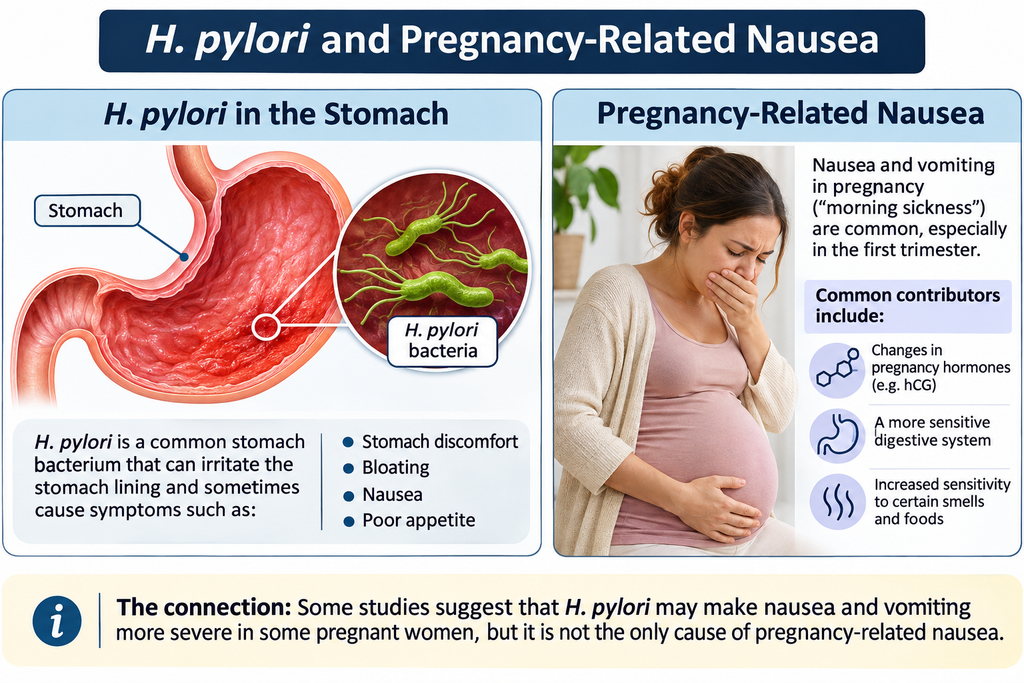
Some researchers believe that chronic stomach inflammation associated with H. pylori may contribute to nausea and vomiting in certain pregnant women.
Studies have reported higher rates of H. pylori infection among women with hyperemesis gravidarum than among women without it.
A 2026 systematic review also found an association between H. pylori and hyperemesis gravidarum.
That finding does not establish that H. pylori is the cause. Pregnancy-related vomiting has several possible contributing factors, including hormonal changes and individual susceptibility.
H. pylori may be relevant in some cases, but it is not an established explanation for every case of severe pregnancy sickness.
H. pylori and Iron-Deficiency Anaemia During Pregnancy
Iron deficiency is a recognised concern during pregnancy because the body needs additional iron to support maternal health and the developing baby.
H. pylori has also been studied in relation to iron deficiency and iron-deficiency anaemia.
Chronic stomach inflammation may affect iron metabolism and absorption. Researchers have proposed several possible mechanisms, including reduced iron availability, changes in stomach acidity and the effects of ongoing inflammation.
Some studies have found a relationship between H. pylori infection and lower iron levels or iron-deficiency anaemia.
Pregnancy adds another consideration because iron requirements increase as the pregnancy progresses.
It is not established that H. pylori is responsible for iron deficiency in every pregnant woman who has the infection. Other causes, including increased iron requirements, dietary intake and blood loss, also need consideration.
If blood tests show iron deficiency or anaemia during pregnancy, your healthcare provider can assess the possible causes and decide whether further investigation is appropriate.
H. pylori and Pre-eclampsia
Pre-eclampsia is a pregnancy complication involving high blood pressure and signs that other organs may be affected.
It usually develops after 20 weeks of pregnancy and requires medical monitoring.
Researchers have investigated whether chronic infections, including H. pylori, may be associated with pre-eclampsia.
One proposed explanation involves the body’s inflammatory and immune responses. Researchers have also investigated possible effects on blood vessel function and the biological processes involved in placental development.
The 2026 systematic review reported an association between H. pylori and pre-eclampsia.
This does not establish a direct cause-and-effect relationship. Other maternal, genetic and pregnancy-related factors may influence the development of pre-eclampsia.
H. pylori testing is not a substitute for routine antenatal blood pressure checks or other pregnancy monitoring.
If you experience severe or persistent headaches, visual disturbances, severe pain beneath the ribs or sudden swelling of the face and hands, seek urgent maternity assessment. These symptoms can have several causes, but they require prompt medical attention during pregnancy.
Can H. pylori Affect the Developing Baby?
This is understandably one of the biggest concerns for expectant parents.
Researchers have investigated possible associations between maternal H. pylori infection and outcomes such as:
- Preterm birth.
- Restricted fetal growth.
- Small-for-gestational-age birth.
- Low birth weight.
Some studies have reported associations, but the evidence remains uncertain.
It is not possible to conclude from these findings that H. pylori directly affects fetal development. Other factors, including maternal health, nutrition, socioeconomic conditions and access to antenatal care, may influence the results.
The 2026 meta-analysis found an association with preterm birth and small-for-gestational-age outcomes. It also highlighted limitations in the underlying observational evidence.
If you have H. pylori during pregnancy, your obstetrician can consider your overall health, nutritional status and any other pregnancy-related risk factors when deciding what monitoring you need.
A positive H. pylori result alone does not establish that your baby is at risk.
Should You Be Tested for H. pylori During Pregnancy?
Routine H. pylori testing is not currently recommended for every pregnant woman.
A positive association in research does not provide enough evidence to justify screening all expectant mothers.
Testing may be considered when there is a specific clinical reason, but the decision depends on symptoms, medical history and the circumstances of the pregnancy.
For example, a woman experiencing persistent or severe upper digestive symptoms may need further investigation. In cases of severe, treatment-resistant hyperemesis gravidarum, a clinician may consider whether H. pylori is one possible contributing factor.
The decision should involve the obstetrician and, where appropriate, a gastroenterologist.
What tests are available?
Common H. pylori diagnostic methods include:
- Stool antigen testing.
- Urea breath testing.
- Endoscopy with gastric biopsy.
- Other laboratory methods where clinically appropriate.
The choice depends on the reason for testing and the patient’s circumstances.
An endoscopy is not normally performed simply to screen for H. pylori during pregnancy. A specialist would consider whether the expected clinical benefit justifies an invasive procedure.
Your healthcare provider should also consider whether a test can be performed at the appropriate time and whether medication use could affect the result.
Can H. pylori Be Treated During Pregnancy?
This is where individual medical assessment becomes especially important.
Standard H. pylori treatment usually involves a combination of medicines, including antibiotics and an acid-suppressing drug.
Some commonly used H. pylori medicines are not appropriate during pregnancy. The suitability of other medicines depends on the specific drug, pregnancy stage, medical history and clinical circumstances.
For this reason, routine treatment is generally not recommended during pregnancy when there is no compelling clinical reason to proceed.
A New Zealand primary-care review advises that investigation and treatment are usually deferred until after childbirth. It also describes specialist-led assessment in selected cases of severe pregnancy-related vomiting that does not improve with standard medical treatment.
This should not be interpreted as a recommendation to treat H. pylori during pregnancy. The potential benefits and risks need to be assessed for the individual patient.
Do not start, stop or change antibiotics, acid-reducing medication or supplements without discussing them with your healthcare provider.
Why is conventional treatment often delayed until after childbirth?
There are several considerations:
- Medication exposure: Some H. pylori treatment combinations contain medicines that are unsuitable during pregnancy.
- Clinical urgency: Many women with H. pylori do not have complications requiring immediate treatment .
- Uncertain benefit: Current evidence does not establish that routine treatment during pregnancy improves pregnancy outcomes.
- Individual circumstances: A clinician must weigh the risks of untreated disease against the possible risks of medication exposure.
After childbirth, your healthcare provider can reassess whether testing and treatment are appropriate.
What About Natural or Herbal Options?
Some women wonder whether a herbal option could be used during pregnancy or while breastfeeding. Matula Tea is a proprietary herbal formula made from wild-harvested Southern African plants.
However, we have not conducted clinical studies establishing the safety of Matula Tea during pregnancy or breastfeeding. We therefore can’t recommend it during pregnancy or breastfeeding.
If you are pregnant or breastfeeding, speak with your obstetrician or healthcare provider before considering Matula Tea or any other herbal supplement. Your health and your baby’s safety should come first.
Women who wish to explore the Matula Tea program can discuss whether it may be appropriate after pregnancy and breastfeeding.
What If You Have H. pylori and Are Planning a Pregnancy?
If you already know that you have H. pylori and are planning to become pregnant, it may be worth discussing the infection with your healthcare provider before conception.
This gives you an opportunity to review:
- Whether active infection has been confirmed.
- Whether you have a history of peptic ulcers or significant digestive symptoms.
- Whether treatment is appropriate before pregnancy.
- Which medicines are suitable for your circumstances.
- Whether follow-up testing is needed after treatment.
There is no guarantee that treating H. pylori before pregnancy will prevent pregnancy complications. The evidence does not establish that outcome.
The benefit of discussing it beforehand is that you and your clinician can consider the available options before pregnancy-related medication restrictions become relevant.
What Should You Do If You Have H. pylori During Pregnancy?
If you receive a positive H. pylori result while pregnant, avoid making treatment decisions based on internet advice alone.
Start by discussing the result with your obstetrician or healthcare provider.
They can review your symptoms, medical history, test results and pregnancy stage.
If you are experiencing severe vomiting, inability to keep fluids down, dehydration, rapid weight loss or reduced urination, seek prompt medical assessment. Hyperemesis gravidarum can require treatment with fluids, anti-nausea medication and nutritional support.
The Royal College of Obstetricians and Gynaecologists provides guidance on the assessment and management of nausea and vomiting during pregnancy.
Do not assume that H. pylori is the cause of your symptoms. Other conditions may need investigation.
Frequently Asked Questions
1. Can H. pylori cause morning sickness?
Research has found an association between H. pylori infection and hyperemesis gravidarum, the severe form of pregnancy-related nausea and vomiting. It has not established that H. pylori causes ordinary morning sickness or that it explains every case of hyperemesis.
2. Does H. pylori increase the risk of miscarriage?
Some older studies have investigated possible associations between H. pylori and pregnancy loss. The available evidence does not establish that H. pylori causes miscarriage. A positive result should not be interpreted as evidence that a pregnancy will be lost.
3. Can H. pylori pass from mother to baby during pregnancy?
H. pylori is generally acquired through oral-oral or faecal-oral transmission. There is no established evidence that ordinary maternal H. pylori infection routinely passes to the developing baby through the placenta.
4. Should every pregnant woman have an H. pylori test?
No. Current evidence does not support routine screening of all pregnant women. Testing should be based on individual symptoms, medical history and clinical assessment.
5. Can I take antibiotics for H. pylori while pregnant?
Some medicines used in H. pylori treatment are unsuitable during pregnancy. Other medicines require individual risk assessment. Do not start any treatment unless your obstetrician or another appropriate specialist has assessed the risks and benefits.
6. Is it better to treat H. pylori before becoming pregnant?
If you know you have an active infection and are planning pregnancy, discuss it with your healthcare provider. They can consider whether treatment before conception is appropriate. There is no established evidence that doing so prevents pregnancy complications.
Key Takeaways
- H. pylori is a stomach bacterium that can cause chronic inflammation and peptic ulcers.
- Research has reported associations between H. pylori and several pregnancy-related conditions.
- The available evidence does not establish that H. pylori causes these complications.
- Routine screening and treatment during pregnancy are not currently supported by the available evidence.
- Testing and treatment decisions should be made with your obstetrician or another appropriate healthcare professional.
Understanding the Research Without Unnecessary Concern
Research into H. pylori and pregnancy continues to develop. The findings are worth understanding, particularly for women who already have a confirmed infection or are experiencing severe digestive symptoms.
At the same time, the evidence needs to be interpreted carefully.
A positive H. pylori result does not mean that you or your baby will experience a pregnancy complication. It also does not mean that immediate antibiotic treatment is necessary.
The most useful next step is an individual discussion with your healthcare provider, who can consider your symptoms, medical history and stage of pregnancy.
This information is for educational purposes only and is not intended as medical advice. Please consult your healthcare provider for diagnosis and treatment decisions.
References
- Ahmadi S, Ardalani P, Ahmadi S, Moradi Y, Ghadirzadeh B. The effect of Helicobacter pylori infection on pregnancy and fetal complications: a systematic review and meta-analysis. Journal of Maternal-Fetal & Neonatal Medicine. 2026.
https://pubmed.ncbi.nlm.nih.gov/41748262/ - Besnier M, Joseph JY, Laurandeau A, Burucoa C, Pichon M, Frèche B, Poupin E. The impact of Helicobacter pylori infection on Pregnancy: A narrative review. European Journal of Obstetrics & Gynecology and Reproductive Biology. 2026.
https://doi.org/10.1016/j.ejogrb.2026.115279 - bpacnz. H. pylori: who to test and how to treat. Published 2022. Updated August 2026.
https://bpac.org.nz/2022/h-pylori.aspx - Nelson-Piercy C, Dean C, Shehmar M, Gadsby R, O’Hara M, Hodson K, Nana M. The Management of Nausea and Vomiting in Pregnancy and Hyperemesis Gravidarum (Green-top Guideline No. 69). BJOG. 2024;131(7)e1–e30.
https://pubmed.ncbi.nlm.nih.gov/38311315/ - Royal College of Obstetricians and Gynaecologists. Pregnancy sickness: nausea and vomiting of pregnancy and hyperemesis gravidarum.
https://www.rcog.org.uk/for-the-public/browse-our-patient-information/pregnancy-sickness-nausea-and-vomiting-of-pregnancy-and-hyperemesis-gravidarum/